
Phase & Polarization
Imaging Technology
A detailed account of OPIRIS's birefringent diffractive mask architecture, enabling simultaneous capture of both the scalar and vector parameters of the light wave in a single acquisition.
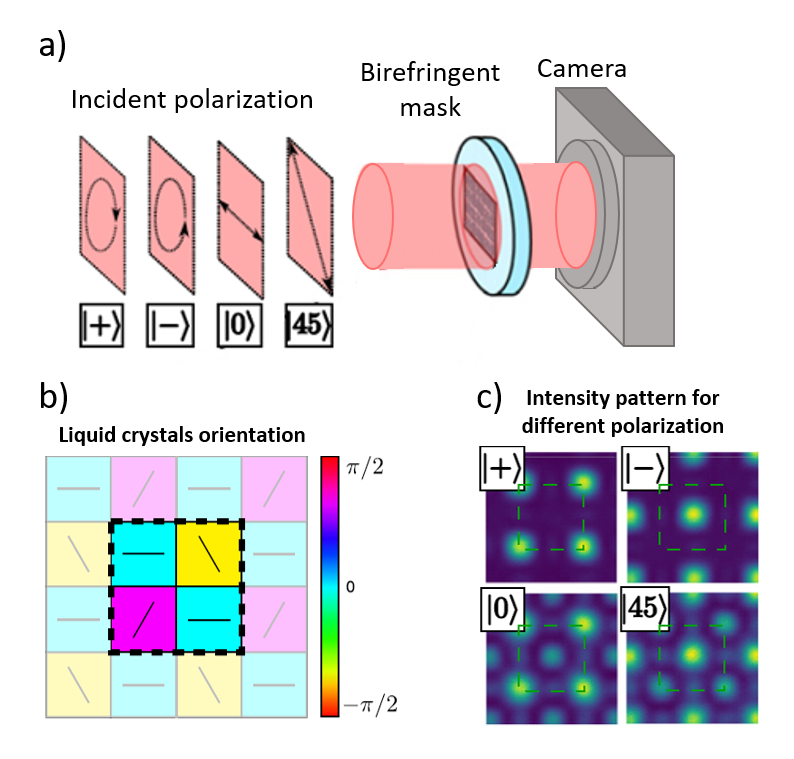
Physical and Optical Principles
Unlike standard cameras that measure only intensity (I), the OPIRIS system accesses both phase (φ) and the full polarization state of the wave vector simultaneously.
Material Specifications and Fabrication
The mask is fabricated from liquid crystals oriented between two glass plates via photo-alignment layers, using technology analogous to modern LCD screens.
Signal Processing and Resolution
The technology employs spatial frequency domain multiplexing. To reconstruct the full 4-dimensional polarization space, physical sensor pixels are grouped into macropixels, trading raw spatial resolution for quantitative information at every point.
Optical Integration and Form Factor
Form factor reduction is the central challenge of the current development phase.
Comparative Analysis and Competitive Advantages
Compared to existing polarimetric and phase imaging approaches, the OPIRIS mask architecture offers a unique combination of single-shot acquisition, no moving parts, and compatibility with standard sensor platforms.
| Capability | Standard Camera | Rotating-element Polarimeter | OPIRIS Mask |
|---|---|---|---|
| Intensity I | Yes | Yes | Yes |
| Full Stokes polarization | No | Yes | Yes |
| Phase φ | No | No | Yes |
| Single-shot acquisition | Yes | No | Yes |
| No moving parts | Yes | No | Yes |
| Vibration-robust | Yes | No | Yes |
| Drop-in sensor integration | Yes | Partial | Yes |
| Flux efficiency | 100% | 50% | ~100% (Phase+Pol) |
Defense and Industrial Use Cases
Mask Microstructure — The "Rods"
The mask is a two-dimensional grating, not merely a spectral filter. Its spatial encoding of polarization state is what enables single-shot full Stokes acquisition.
Interference Mechanism — Semi-Interferometry
Unlike Mach-Zehnder or Michelson interferometers that require a separate reference arm, OPIRIS implements semi-interferometry: the beam interferes with its own spatially shifted replica through the mask.
Loss Management — The 50% Trade-off
Depending on the operating mode, the system handles the photon budget in fundamentally different ways.
Biological Analogy — Insect Vision
Many insects use polarization to identify bodies of water. The surface of calm water produces a highly polarized reflection that is distinct from surrounding terrain, allowing navigation without visual landmarks.
Hardware Integration Constraints
Sources and Wavelengths
The system is designed to operate across the SWIR band, with specific configurations for active and passive imaging scenarios.
OPIRIS